
Enjoying the build process is a useful starting point, but it does not prove that enough customers will pay for the finished service. A custom PC building business needs a clear customer niche, disciplined spending, and useful support after delivery. Demand, margins, and after-sale support matter as much as careful assembly.
You can test the market before buying parts, then shape an offer around what people actually want. A part-time start can limit financial exposure while you learn which builds sell and how much support customers need. The work also includes quoting, testing, documenting, and earning trust, not just choosing components.
Key Takeaways
- Check real customer interest before stocking parts.
- Choose a reachable niche with a clear reason to buy.
- Track costs, labor, and customer acquisition expenses.
- Document testing, warranties, and support for every order.
- Grow only when order volume and cash flow support it.
Treat the first few orders as a test of demand and a chance to earn trust, not proof that a steady stream of sales is guaranteed.
How Can You Validate Demand Before Buying Parts?
Before ordering a single component, find a specific group of buyers with a reason to choose a custom build over an off-the-shelf PC. Demand validation means checking whether likely customers show real interest before you commit money to inventory. A large market does not prove that local customers will buy from you.
Find a specific buyer and use case
Gamers, content creators, and local professionals all need different systems. Narrow the idea by budget, performance needs, customization, and support. A gamer might want quiet 1440p performance, while a video editor may value memory, storage, and dependable file handling.
Look for a niche you can reach, not just one that sounds exciting. A local professional may prefer setup at their office, while gamers may care more about component choices and upgrade paths. The market only helps if you can speak with its likely customers.
Check local and online competition
The global gaming PC market was worth roughly $70 billion in 2025, but that scale says little about demand in your town. Observe build choices on Reddit’s r/buildapc and PCPartPicker’s completed builds gallery. Compare regional builders with national options such as NZXT BLD.
- Review completed builds and note recurring component choices and prices.
- Ask likely buyers what frustrates them about ready-made PCs and existing builders.
- Compare local shops, service promises, and national builder offers.
- Test interest with a clear sample offer before buying stock.
Do not buy inventory until at least a few likely customers have shown interest in the same kind of build.
Keep notes on the needs people repeat, not only the features they praise. A niche is useful when you can reach its buyers and offer a difference they value.
How to Start a Custom PC Building Business on a Lean Budget
Plan on a $6,000-$18,000 estimated startup budget in 2026, with initial inventory taking the largest share. Inventory can absorb cash before your first sale, so a small business should stock carefully. Keep speculative, slow-moving parts out of your early plan.
These estimates describe startup spending, not a cash reserve for monthly bills. Your actual choices will depend on how many orders you can fulfill and which parts customers request. The table shows where the initial money may go.
| Expense | Estimated range in 2026 | Budget implication |
|---|---|---|
| Total startup budget | $6,000-$18,000 | Plan a spending ceiling |
| Initial component inventory | $5,000-$15,000 | Largest expected share |
| Website and e-commerce setup | $500-$2,000 | Keep the first store simple |
| Business formation | $100-$800 | Costs depend on location and structure |
| Basic tools | $200-$500 | Cover essential assembly work |
Inventory dominates the estimate, so favor fast-moving, broadly useful components. Avoid tying up money in niche high-end parts until customer orders justify them. Hardware can lose value as newer products arrive, and unsold components may leave less money for operating costs.
Build the first inventory around repeat demand rather than personal preference. Some owners can keep spending lower by ordering components for approved builds instead of trying to offer every option on hand. Keep reserves for routine expenses separate from the amount you plan to spend on startup items.
Set a spending ceiling before shopping and keep custom or slow-moving components out of the first inventory plan.
What Legal, Tax, and Insurance Setup Do You Need?
Before taking paid orders, check your state’s registration and sales-tax rules and your city’s licensing requirements. Local rules differ, so a single permit or business structure is not mandatory everywhere. Confirm requirements with state and local authorities before operating.
Register and handle sales tax
An LLC is a common structure to consider, but it is not a universal requirement or a substitute for insurance. A free EIN is a nine-digit federal tax ID, and an online application through the IRS usually provides it within minutes. Use it for business records and open a separate business bank account.
Check with your state Department of Revenue about seller-permit rules and sales tax on computers, parts, and services. A city or county may also require a general business license. A local general business license often costs $50-$100 per year, though the requirement depends on your location.
Cover liability and business property
General liability insurance can help with claims involving injury or property damage. Professional liability generally addresses claims tied to errors in the service you provide. In 2026, a $1 million general liability policy is estimated at $250 to over $3,000 annually, depending on risk factors; a $1 million professional liability policy is estimated at $500-$1,000 per year.
- Choose and register a business structure that fits your situation.
- Apply for an EIN through the IRS.
- Check seller-permit and sales-tax rules with your state Department of Revenue.
- Verify city or county licensing requirements.
- Open a separate business account and obtain insurance quotes.
Property coverage may matter when you keep inventory or tools at your workspace. Workers’ compensation may apply if you hire employees, and commercial auto coverage may fit business deliveries. Ask an insurance professional which policies match your actual work and risks.
Requirements vary by state and locality, so consult the relevant authorities or a qualified tax or legal professional for advice. Verify each obligation directly with the relevant authority before relying on a generic checklist.
How Should You Set Up a Workspace and Source Parts?
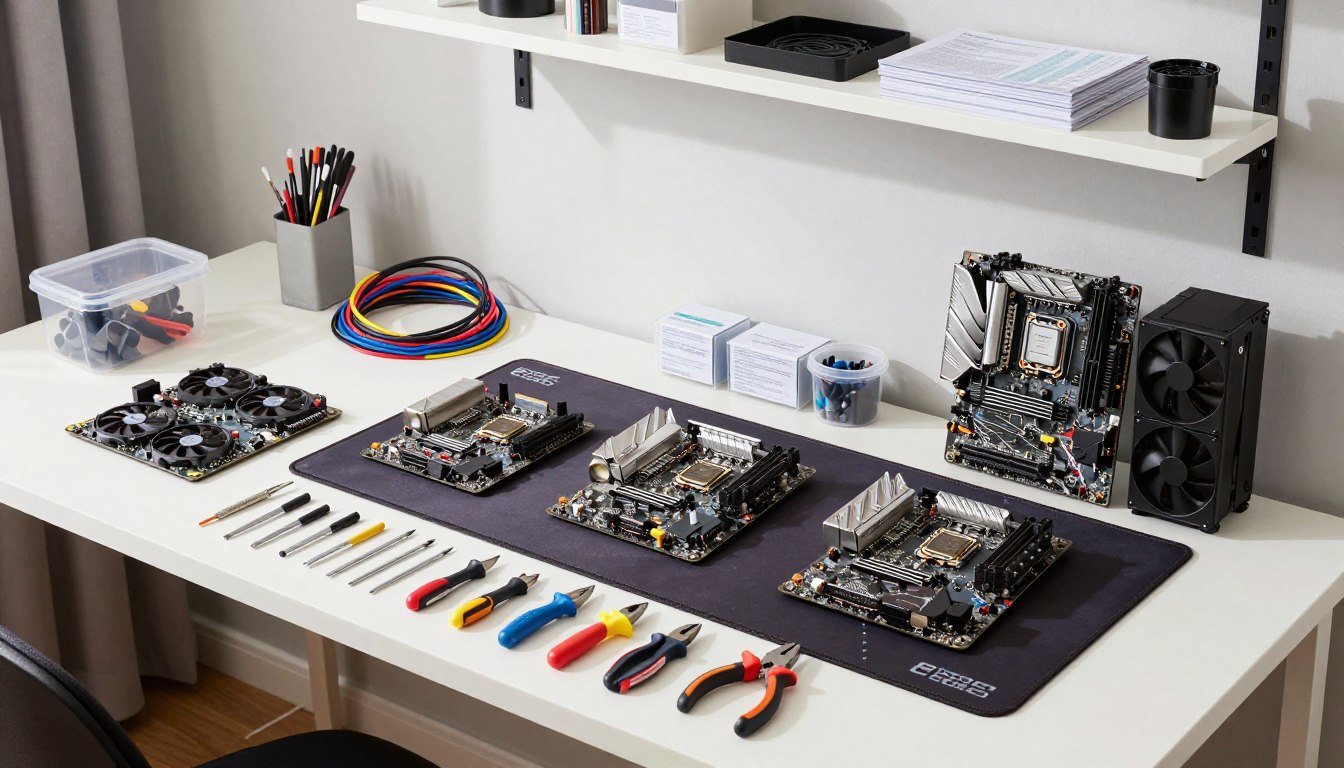
A spare room or clean garage corner can be enough to start if the work surface is static-safe and the parts stay organized. Keep the space simple, with clear room to assemble, test, and pack each system. A 100-150-square-foot workspace is described as sufficient to start in 2026.
Make a small, static-safe build station
Use a clean, uncluttered area and a static-safe surface. Store components in labeled bins, away from dust and accidental knocks. A 6-foot anti-static workbench is estimated at $400-$800 in 2026, while cable-management supplies such as Velcro straps and zip ties are estimated at $50.
An iFixit Pro Tech Toolkit is estimated at $75-$100 in 2026. An electric air duster is estimated at $50-$60. Keep small screws and adapters in labeled containers so they do not disappear between jobs.
Choose suppliers without overstocking
Newegg Business and Amazon Business are retail purchasing options. As order volume grows, investigate distributors such as Ingram Micro and D&H; their account terms and pricing are not guaranteed. Compare delivery time and return rules before placing an order.
Hardware can lose value as newer products arrive, so a confirmed order is safer than speculative quantities. Check component compatibility before committing, including motherboard support, memory type, case clearance, and power needs. Review supplier return rules, since the return window can shape how quickly you need to test incoming parts.
Do not let a discount turn into an oversized stockpile. Keep components in their original packaging until needed, and note any damaged packaging when a shipment arrives. Keep a record of each component’s cost, supplier, and return deadline as soon as it arrives.
Which Services Make the Business More Valuable to Customers?
Customers pay for a solution to a need, so pair the build itself with setup or support that makes the finished system easier to use. A PC builder can offer assembly alongside upgrades, diagnostics, repair, software installation, and ongoing support. Define the service around what you can deliver reliably.
Gaming desktops typically cost $1,000 to over $4,500 in 2026. The GPU has the biggest impact on gaming performance and price, so it often drives the customer’s main tradeoff. Typical GPU ranges are $300-$600 for entry-level, $700-$1,000 for mid-range, and $1,500-$4,000 or more for high-end builds.
| Gaming tier | Typical system price | Target resolution | Typical performance |
|---|---|---|---|
| Entry-level | $1,000-$1,200 | 1080p | 60+ FPS, medium-to-high settings |
| Mid-range | $1,200-$2,200 | 1080p-to-1440p | 100+ FPS at 1440p, high settings |
| High-end | $2,200-$4,500 or more | 1440p-to-4K | 140-200+ FPS at 1440p |
Entry-level builds typically start with 16GB of DDR5 RAM and a 512GB-1TB SSD. Mid-range and high-end systems typically use 32GB or more of RAM and at least 2TB of storage. Typical CPU ranges are $150-$400, $250-$600, and $400-$800 across those tiers.
Pair builds with setup and ongoing support
Offer setup, software installation, data transfer, or a scheduled check-in when those tasks fit your skills. Micro Center provides an example of clearly bounded service: selected-component installation and Windows setup, cooler installation, one year of complimentary ESET NOD32 Antivirus, and a 90-day labor warranty. Its optional two- or three-year protection plans can be bought within 30 days of the original order.
Add specialist work through partners
A dependable 650W-or-higher power supply becomes increasingly important in higher-power builds. For network installation or specialized software work, partner with a qualified provider rather than promising a service you cannot competently deliver. Treat Micro Center’s service details as an example of defining installation, software, labor warranty, and optional protection boundaries, not as an endorsement.
Put every included service and every excluded task in writing before quoting a system.
How Should You Price Builds and Collect Payment?
A quote should cover the parts, your labor, transaction costs, and the support you promise, not just the markup. Cost-plus pricing commonly adds a 15%-25% markup on parts, while a fixed build fee may be $200-$500 depending on complexity. Markup is not take-home profit.
With cost-plus pricing, you calculate the parts cost and add the agreed markup. With a flat build fee, you charge a set amount for the assembly work, then list parts separately. A clear quote lets customers see what they are paying for and gives you a way to compare jobs.
For example, a $1,500 parts cost with a 20% markup adds $300 before other expenses. That amount is not guaranteed profit. Labor, shipping, payment processing, taxes, warranty work, and overhead all reduce what remains.
Payment terms described for 2026 may require a 50% non-refundable deposit before ordering parts, with the remaining 50% due at completion or delivery. Non-refundable terms are not enforceable in every jurisdiction, so confirm contract language under applicable law before using it.
Get written approval for the parts list, quote expiry, cancellation terms, delivery method, and warranty scope. State what happens if a component becomes unavailable or a customer requests a change after ordering. Have a local professional review deposit and cancellation language before using it with customers.
What Should Every Build’s Order and Testing Process Include?
A written approval checkpoint before ordering prevents a vague request from turning into an expensive parts dispute. Use the same sequence for each job, from requirements through delivery and support handoff. Document the customer-approved specification before you buy components.
Confirm the order before buying parts
Start with the customer’s written requirements, then prepare a compatible parts list and quote. Get approval and the agreed deposit before ordering. After parts arrive, assemble the PC, run tests, record results, and arrange delivery with clear support instructions.
Trello or Asana can organize work stages, due dates, and customer updates. A simple board can show whether a job is waiting for approval, parts, assembly, testing, or handoff. That visibility helps you spot a stalled order before it becomes a surprise.
Test, document, and hand over each system
Use a repeatable quality check for every system:
- Inspect the components, connections, and cable routing before powering on.
- Confirm the BIOS and operating system start correctly.
- Check temperatures and stability under load.
- Record serial numbers and save test results.
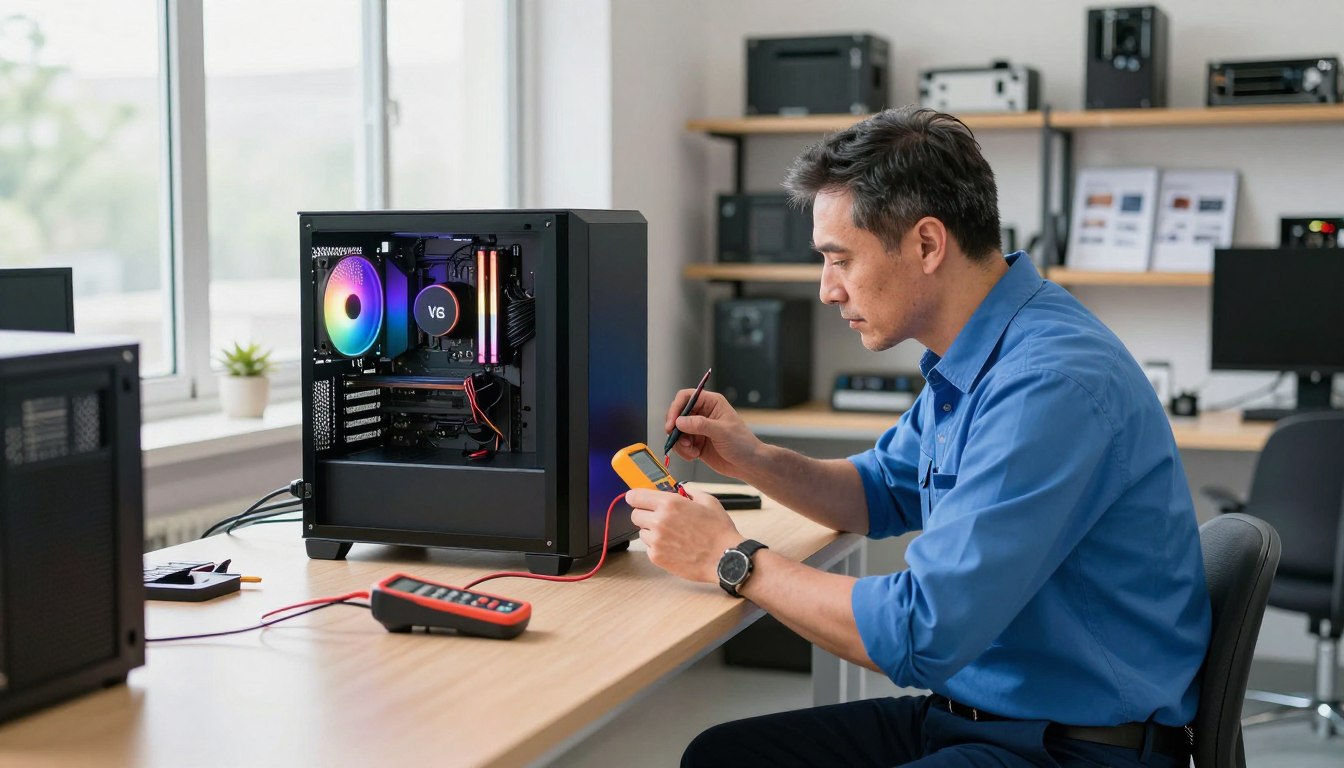
Prime95 is used for CPU stress testing for at least 60 minutes. FurMark is used for GPU testing for the same duration, and MemTest86 checks RAM stability. Save the test results with the job record so you can answer questions about the system later.
An RMA is a return merchandise authorization. Record the vendor’s return instructions and keep evidence, such as error messages and test results, before troubleshooting a suspected defect. The return window and evidence can help guide the next steps without confusing a faulty part with a setup issue.
Give each finished PC a dated build record with its parts list, test results, and any agreed support terms.
How Can You Take Custom PC Orders Online?
An online storefront can collect leads and approvals, but it should not let a customer order a complex build without confirming the specification. Use an intake form for budget, use, location, preferences, and timing, followed by a quote-approval step before payment. Processing fees reduce the money left from each sale.
Starting a custom PC building business online means making the order path clear on a phone or computer. Shopify Basic costs $39 USD per month billed monthly or $29 USD per month billed yearly in 2026. Basic includes 10 inventory locations and unlimited product listings.
| Transaction type | Standard rate on Basic | Condition |
|---|---|---|
| Shopify Payments online card | 2.9% plus 30¢ | Online card transaction |
| Shopify Payments in-person card | 2.6% plus 10¢ | In-person card transaction |
| Third-party payment provider fee | 2% | Shopify fee on Basic |
POS Pro costs $89 per month per location in 2026. Include the relevant payment cost in your margin planning, and make sure the storefront presents custom work as a quote-and-approval process rather than a one-click product. Test the full inquiry, quote, payment, and confirmation flow on a phone before sending customers to the site.
How Do You Find Customers Without Overspending?
A clear photo of a finished build can show cable management, component choices, and workmanship more convincingly than a broad sales claim. Show real work so customers can judge what they would receive. Keep customer acquisition cost, or CAC, below 10% of the PC’s sale price as a planning target.
Build a visual portfolio
Photograph completed builds from several angles, including the inside of the case. Short build videos on Instagram, TikTok, or YouTube Shorts can show assembly choices and testing. Use each post to explain a specific design decision instead of making a broad claim about quality.
A video does not need a complicated setup. A steady phone, clear lighting, and a few close shots of the finished system can make the work easy to assess. Ask permission before showing a customer’s name, room, or personal details.
Earn trust in communities and local channels
Use helpful participation to build familiarity, not unsolicited ads. Reddit’s r/buildapc and Linus Tech Tips are places to answer questions and share useful knowledge. Local business and community groups may allow promotion, so follow each group’s rules.
- Post short build videos on Instagram, TikTok, or YouTube Shorts.
- Answer questions helpfully in relevant communities.
- Use local business and community groups where promotion is allowed.
- Ask satisfied customers for referrals after a good handoff.
CAC is the amount you spend to win one customer. A planning target below 10% of the PC’s sale price means spending no more than $200 to win a customer for a $2,000 build. That is a guide, not a guarantee that a channel will bring sales.
Track the source of every inquiry so you can stop paying for promotion that does not produce qualified leads.
How Can You Fund the Business and Track Cash?
A business can show a sale on paper and still run short of cash if supplier bills arrive before customer payments clear. Working capital is cash available for routine expenses and gaps between paying suppliers and receiving customer funds. Plan for cash timing, not just booked sales.
A working-capital reserve of $3,000-$7,000 is a planning estimate for three to six months of expenses. Adjust it to your actual overhead and how orders move through the business. Personal savings offer flexibility but put your own money at risk; a separate business account keeps records clearer.
A small-business loan can add funds, but repayment reduces future cash. SBA Microloans are available up to $50,000, with an average loan of about $13,000 and general interest rates of 8%-13%. Applicants usually need a personal credit score above 650, but those details do not promise approval.
Track parts, shipping, payment fees, labor, software, taxes, refunds, and warranty work in a spreadsheet using Google Sheets or Excel. Review each job’s costs against its sale so you can spot work that consumes more time or support than expected.
Owner draws are not the same as profit. A draw moves money to you; profit is what remains after business costs and obligations. Reconcile the business account monthly and set aside money for taxes instead of treating every incoming payment as spendable income.
When Should You Hire or Expand?
Hire when the time spent building and supporting orders is limiting sales or causing a consistently long queue, not just because one busy week feels overwhelming. Use volume as a signal, not an automatic trigger. Payroll must fit the cash the business can reliably support.
Hiring may become relevant around 5-10 builds per month, especially when the queue stays longer than two weeks. Those are planning signals, not fixed rules. Check whether customer demand can support the added hours and whether you can train someone without lowering service quality.
A first part-time technician may handle assembly, cable management, and quality checks. Estimated pay is $20-$25 per hour. A rough planning target is one full-time technician per $150,000-$200,000 in annual revenue, but the right staffing level also depends on build complexity and support demands.
Inventory software such as Katana or QuickBooks Commerce may become useful when volume regularly exceeds 15 builds per month. Before expanding, consider whether better scheduling or workflow changes could clear the queue without adding a new role.
Set a written hiring trigger that accounts for workload, cash available for payroll, and the time needed to train someone.
Keep the trigger tied to repeated workload and service quality, rather than one unusually busy stretch. Review it alongside order timing and the hours needed for after-sale support.
Conclusion
A sustainable start comes from solving a clear customer problem and delivering the promised support, not from stocking every popular component. Customer fit and reliable service matter more than a packed shelf. Judge early progress by whether customers understand the offer and receive the experience you promised.
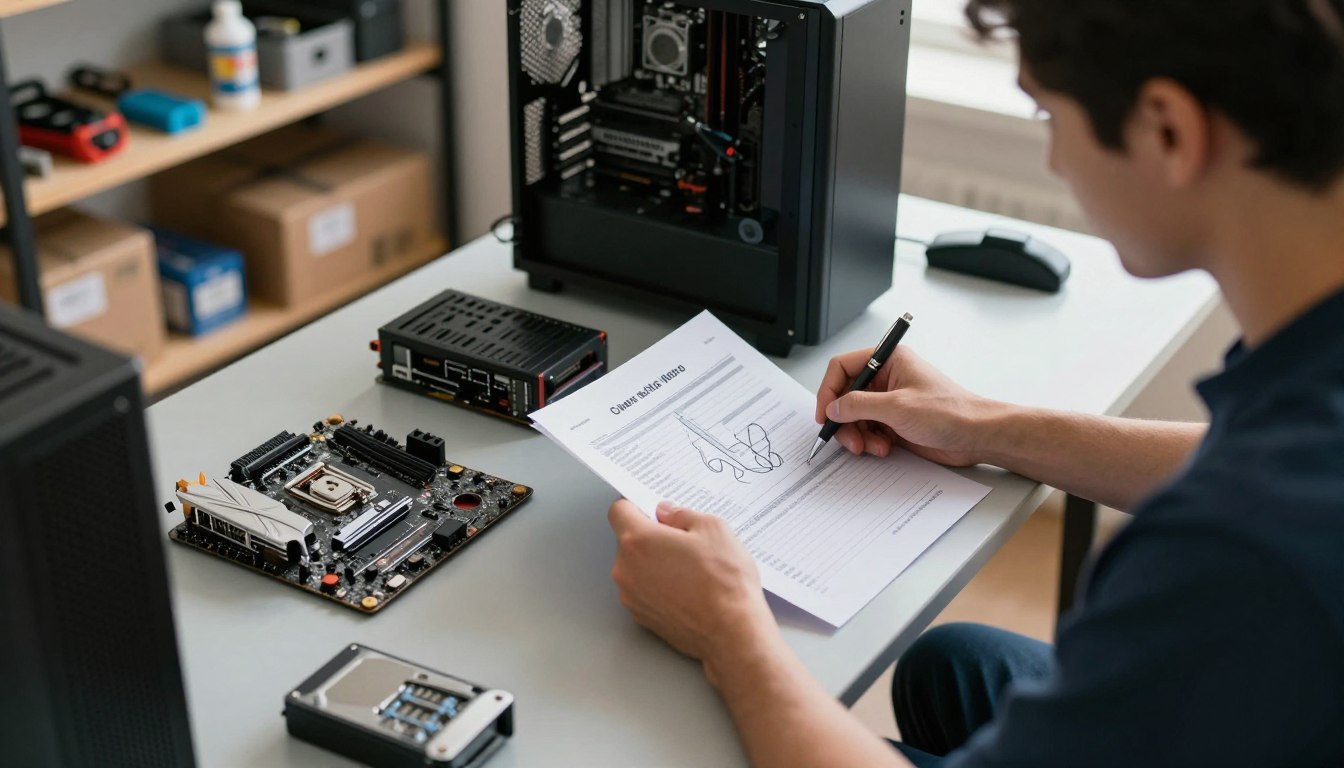
Make the first goal a small, documented order that tests your offer and creates a useful customer experience. One well-managed job can reveal where your quote, build process, or handoff needs work. It can also give you a real example to discuss with the next likely buyer.
Choose one customer group, speak with a few likely buyers this week, and use what you learn to shape your first written offer.
FAQ
Can I start a custom PC building business without keeping parts in stock?
Yes, you can begin with customer-approved, order-specific parts and keep only stock justified by repeat demand and cash flow. This approach limits the chance of holding components that lose value before a buyer wants them. Confirm the exact specification before ordering, and keep the supplier’s return deadline in your job record.
How much cash should I keep aside for operating expenses?
A planning estimate is $3,000-$7,000 for three to six months of expenses, adjusted to your actual overhead and order timing. Your reserve needs to cover routine bills and gaps between supplier payments and customer funds clearing. Track monthly costs so you can update the target when sales or expenses change.
Do I need a seller’s permit to sell custom PCs?
Requirements depend on your state and locality, so check with your state Department of Revenue and local licensing authority before taking sales. Rules may treat physical parts and services differently. Keep the answers you receive with your business records, and ask a qualified tax or legal professional when your situation is unclear.
How many builds should I be getting before I hire a technician?
Around 5-10 builds per month is a planning signal, but queue length and payroll capacity matter more than a fixed count. A queue that stays beyond two weeks can also suggest that help may be useful. Make sure recurring work can support the hours and training a new technician will need.
Can a customer cancel after I have ordered their parts?
Cancellation terms should be written before work begins, including approval, returns, and any deposit conditions. Whether a particular term is enforceable depends on applicable law, so do not assume that calling a deposit non-refundable settles the question. Explain what happens to special-order parts and get local professional review of the contract language.
Should I sell custom PCs only, or offer repairs and support too?
Consider setup, upgrades, diagnostics, repairs, and ongoing support when those services fit your skills and customer needs. They can give buyers help beyond the initial assembly, but each service also creates time and support demands. Start with work you can deliver well, and describe clearly what your service includes and excludes.
If you want to dig further into is service down? collective ritual of checkin, read our Is Service Down? Collective Ritual of Checkin guide.
If you want to dig further into how to detect ai generated essays key signs a, read our How to Detect AI Generated Essays Key Signs a guide.
If you want to dig further into how to start vending machine business beginne, read our How to Start Vending Machine Business Beginne guide.


 By